
You have a flat commercial roof that needs replacing. Two names keep coming up: TPO and EPDM. Both are single-ply membranes, both are widely used, and both are far cheaper than metal or built-up systems. But pick the wrong one for your climate or building type, and you are looking at higher energy bills, premature seam failure, or a roof that simply does not last as long as it should.
This guide cuts through the noise and gives you a straightforward comparison based on real roofing industry data, contractor experience, and documented performance differences between the two.
What Is TPO Commercial Roofing?
TPO stands for Thermoplastic Polyolefin. It is a single-ply roofing membrane made from a blend of polypropylene and ethylene-propylene rubber, bonded together through a heat-welding process during installation.
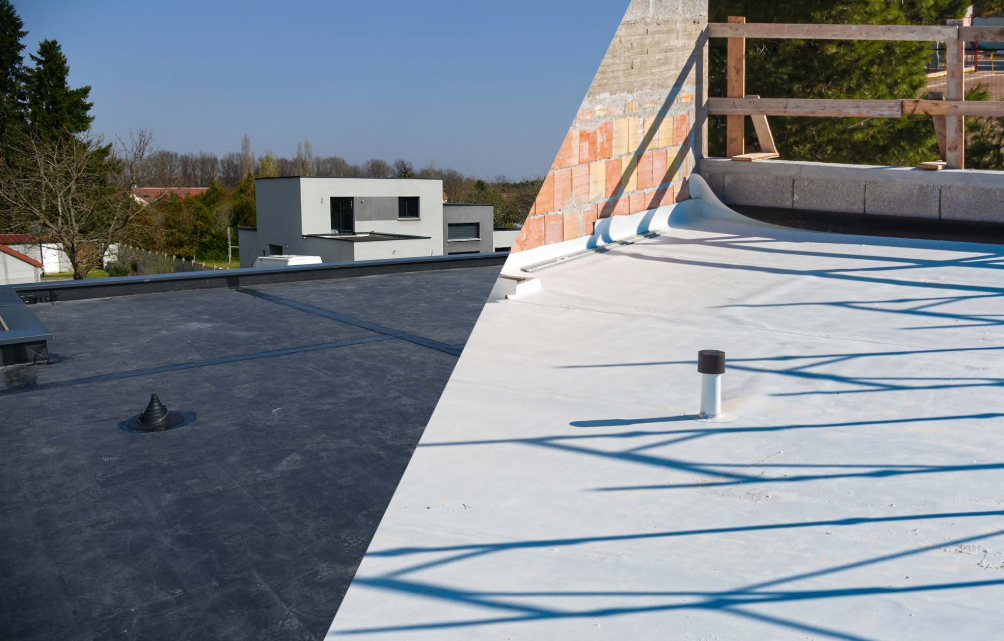
Most TPO membranes come in white or light gray. That ofcolor is not just aesthetic. It reflects UV rays instead of absorbing them, which directly reduces cooling costs in warm climates. This is why TPO has grown so fast. According to the NRCA Market Survey, TPO currently holds roughly 40% of the commercial low-slope roofing market, making it the most popular single-ply option in new construction.
The seams on a TPO roof are heat-welded with hot air guns, creating a bond that is often stronger than the membrane itself when done correctly. This is a meaningful advantage over adhesive-based seam systems because welded seams resist water infiltration far better over time.
What Is EPDM Roofing?
EPDM stands for Ethylene Propylene Diene Monomer. It is a synthetic rubber membrane that has been used on commercial roofs since the 1960s, and that long track record is genuinely one of its strongest selling points.
Most EPDM installations are black, though white versions exist. The rubber material is extremely flexible. It can stretch up to 300% of its original shape and return to form without damage, which matters a lot in climates with dramatic temperature swings. When a roof expands and contracts with the seasons, EPDM handles that movement naturally without cracking or delaminating.
EPDM seams are joined with self-adhesive tape rather than heat welding. This makes installation simpler and requires no special equipment, but it also creates a vulnerability. Adhesive seams are the number one failure point in older EPDM roofs. Contractors and building owners consistently report that seam maintenance is where most of the ongoing repair cost comes from with this system.
On the upside, EPDM has one of the longest lifespans in commercial roofing. A well-maintained roofing system can last 30 to 40 years, and some manufacturers report installations exceeding 50 years under the right conditions.
Durability and Lifespan Comparison
A properly installed EPDM roof regularly lasts 25 to 30 years, and well-maintained systems can push past 40. The rubber composition handles thermal stress exceptionally well. EPDM can withstand temperatures ranging from extreme cold all the way up to around 200 degrees Fahrenheit without losing structural integrity.
TPO typically delivers 15 to 25 years of reliable service. That is a solid lifespan, but it falls short of EPDM when both are maintained correctly. The gap largely comes down to seam performance over time. Heat-welded TPO seams are initially stronger, but TPO membranes are also more susceptible to UV degradation if the formulation is lower quality.
Energy Efficiency and Weather Resistance
This is where climate becomes the deciding factor.
TPO’s white membrane reflects solar radiation rather than absorbing it. In warm climates, this can meaningfully reduce cooling loads. Several states with cool-roof building code requirements effectively push commercial buildings toward TPO because of this. For a warehouse or retail space in Texas, Florida, or Arizona, a white TPO roof can lower air conditioning costs noticeably across a building’s life.
EPDM’s black surface does the opposite. It absorbs solar heat, which works as passive heating in colder climates. Buildings in Minnesota or Wisconsin can see reduced heating costs in winter months because of this. White EPDM is available if you want reflectivity without switching membranes, though it is less common and typically costs more.
On weather resistance broadly, both systems perform well. EPDM’s rubber composition gives it outstanding flexibility in freeze-thaw cycles. TPO has better puncture resistance, which matters on roofs with regular foot traffic or rooftop equipment. Neither system handles standing water well long-term, so both require proper drainage planning regardless of which you choose.
Installation and Maintenance Costs
Both systems are less expensive than alternatives like PVC, spray foam, or metal roofing. Within the two, the cost difference is smaller than most people expect.
EPDM material typically runs $4 to $10 per square foot installed, depending on thickness and attachment method. The three main installation approaches are ballasted (cheapest), mechanically attached, and fully adhered. Ballasted EPDM is the most affordable assembly method and is often used on larger commercial buildings where weight is not a constraint.
TPO generally costs $5 to $12 per square foot installed. Its upfront cost is slightly higher than EPDM in many markets, but its installation is faster in some cases because heat welding can be done efficiently by experienced crews.
On maintenance, TPO tends to require less frequent attention. Its heat-welded seams are more durable than EPDM’s adhesive seams, which means fewer leak calls over the first 10 to 15 years. EPDM seam maintenance is a real and recurring cost that building managers should budget for proactively, not reactively.
Larger commercial projects see lower per-square-foot costs on both systems due to economies of scale. A 50,000-square-foot distribution center will pay significantly less per square foot than a 3,000-square-foot retail pad site.
Which Commercial Roofing System Is Best for Your Building?
The answer depends on four things: your climate, your building’s use, your timeline, and your maintenance budget.
TPO is the stronger choice if:
Your building is in a warm, sunny climate (Southeast, Southwest, or similarly hot regions). You have regular rooftop foot traffic from HVAC technicians or maintenance crews. You want lower cooling costs and you are in a state with cool-roof building code requirements. You plan to own or manage the building for 15 to 20 years and want the lowest initial cost with solid performance.
EPDM is the stronger choice if:
Your building is in a cold or mixed climate where winters are harsh. You want maximum lifespan and plan to hold the asset for 25 to 40 years. You need a system with a long, documented performance history for warranty or financing purposes. Your roof has minimal foot traffic and you want wide-roll installation to reduce seam count.
There are also buildings where either system works fine, and in those cases the decision often comes down to contractor expertise in your area. A contractor who has installed 500 EPDM roofs will do a better job than one installing their fifth TPO system, regardless of which material is theoretically superior for your climate. Ask your prospective contractors how many of each system they have installed.